
A parliamentary panel on Friday recommended for fixing of an upper limit for the economy class airfares to curb the "exorbitant" air fares during the peak tourist seasons.

Let start-ups be start-ups until they become grown-ups, let young entrepreneurs be experimental and bold, let VCs do their job, but for God's sake, the nation must prime the real grown-ups to solve the imminent issues., says R Gopalakrishnan.

Combined net profit of BSE500 companies at $ 63 bn is 2.3% of GDP; global average is 5%.

Despite the large economic impact of the Covid-19 pandemic, the markets have recovered sharply even though the performance among individual stocks has been quite polarised.

The implementation of the GST will indeed be a landmark reform.

Could it be about clout? Given its size and influence, RIL doesn't need the media for that, notes Vanita Kohli-Khandekhar.

Government's push for Make in India which focuses on select 26 sectors and improving the 'ease of doing business' will aid the manufacturing/industrial growth.

Asian Development Bank (ADB) has kept its outlook for India's economic growth unchanged at 7 per cent for the current fiscal year while forecasting a weaker-than-previously expected pace for developing Asia. ADB's 7 per cent growth projection for fiscal 2022-23 (April 2022 to March 2023), unchanged from its September forecast, compares to 8.7 per cent GDP growth in 2021-22. For 2023-24, the GDP growth has been kept unchanged at 7.2 per cent.

Putin made these remarks on Thursday at a forum in Moscow organised by Russia's Agency for Strategic Initiatives (ASI).

Bankers said the outlook of M&As in India in 2024, especially in the second half after the Lok Sabha election, seems relatively better.

'Due to rural stress, volumes continue to remain an issue for the industry, and we are yet to see any revival in demand.'
.jpg)
The Monsoon Session of Parliament will begin on August 5 and the Bill, after its introduction, is likely to be referred to the Standing Committee of Parliament for examination.

The talent is in plenty in this squad and if this machine runs smoothly, a sixth IPL trophy will be at touching distance for Thala and Co.

Maruti Suzuki India's net profit surged 80.3 per cent to Rs 3,716.5 crore in the September quarter, driven by better sales, softening commodity prices, cost reduction efforts and higher non-operating income. The company had delivered a net profit of Rs 2,061.5 crore in the year-ago period, Maruti Suzuki India said in a statement on Friday. Maruti said it is expecting the affordability of small cars in the domestic market to come back in the next 2-3 years in the face of rising income levels of people and a growing economy, among others.


India's economic growth will be above 6 per cent in the current fiscal as the country has managed to strengthen its macroeconomic stability and performance even in a period of large global shocks, RBI Monetary Policy Committee (MPC) Member Ashima Goyal said on Monday. Goyal further said that a global slowdown reducing India's export growth, geopolitics fueling oil and food prices, and erratic weather are some of the continuing risks that the country faces. "India has managed to strengthen its macroeconomic stability and performance even in a period of large global shocks.

Finance Minister Arun Jaitley on Wednesday said the country is on an "upward curve" and a good monsoon, GST passage and increased infra and rural spending will further accelerate the growth.

The Budget oration of the finance minister and the confidence with which she delivered it, along with the measures and the recent upsurge in the economy would all contribute to unleashing the storied 'animal spirits' and help the economy run on the growth path quite smoothly. Or so the government hopes, notes Shreekant Sambrani.

The International Monetary Fund (IMF) warned on Tuesday that India's general government debt (comprising both central and state government debt) could exceed 100 per cent of gross domestic product (GDP) in the medium term. It also cautioned that long-term debt sustainability risks are high due to the significant investment required to meet India's climate change mitigation targets. The Indian government, however, disagreed, arguing that risks from sovereign debt are extremely limited as it is predominantly denominated in domestic currency.

The phone conversation came days after it emerged that Modi will not be travelling to Russia for the annual India-Russia summit this year.

Prime Minister Narendra Modi on Thursday appealed to farmers and other stakeholders associated with the cooperative sector to make GCMMF, which owns the 'Amul' brand, the world's number one dairy company from its current eighth position. He was addressing nearly one lakh people, mostly cattle rearers and farmers, gathered at the Narendra Modi stadium in Motera area of Ahmedabad for the golden jubilee celebration of the Gujarat Cooperative Milk Marketing Federation (GCMMF).

'Demonetisation will push India onto a higher growth path after a temporary dip.'

Fresh formal job creation cooled for the second consecutive month to decline to a six-month low in September, signalling a downturn in the labour markets this financial year. The number of new monthly subscribers under the Employees' Provident Fund (EPF) declined by 6.45 per cent to 891,583 in September from 953,092 in August, shows the latest payroll data released by the Employees' Provident Fund Organisation (EPFO). Besides, the net payroll additions -- calculated by taking into account the number of new subscribers, the number of exits, and the return of old subscribers -- increased by 14.9 per cent to 1.72 million in September from 1.49 million in August.

'You will see more and more people working independently -- starting beauty parlours, driving cars, etc.' This is what we call the gig economy.' 'The same people who have been laid off in India or are unable to get visas to work in the US may be part of this gig economy.' 'India needs billions of jobs, and it can only be created by self-employment or the gig economy.'

"India will be home to a fifth of humanity, its economy 16 times bigger than today, and one of the world's largest consumer markets. India will be a world better in many areas"

Funding winter and corporate governance woes separated the men from the boys in the country's startup space in 2023 that saw funds into the segment tapering to just around $8 billion. All said, investors are hopeful of strong growth of the maturing startup ecosystem in the new year. Edtech and health tech segments that grew exponentially during the pandemic plunged into an abyss of financial uncertainties, with several firms shuttering their business, and valuation of prominent players like BYJU'S and PharmEasy plummeting 85-90 per cent.

'Nobody wants to run an exploitation factory.'

'It will be best for investors to have a systematic investment plan in mid-cap and small-cap funds with a three-/five-year horizon.'

A piece of slightly negative news can cause a serious setback, warns Debashis Basu.

Growth in India is expected to slow to 6.3 per cent in FY 2023/24 (April-March), a 0.3 percentage point downward revision from January, the World Bank said Tuesday but noted there is an unexpected resilience in private consumption and investment and robust growth in the services. The World Bank made these points in its latest edition of Global Economic Prospects according to which global growth is projected to decelerate from 3.1 per cent in 2022 to 2.1 per cent in 2023. In Emerging Markets and Developing Economies (EMDEs) other than China, growth is set to slow to 2.9 per cent this year from 4.1 per cent last year. These forecasts reflect broad-based downgrades.

The growth opportunity for a business, people running the business, governance structure at a company, technology adoption and the firm's belief in frugality are the list of priorities which should be considered before choosing a stock to invest in, Jhunjunwala said.

'The finance ministry and the RBI will never admit to the difficulties in the economy because if they do so, it will adversely impact the financial markets, etc.' 'They like to present a rosy picture that everything is fine and under control.'

Indian equity markets should be able to withstand inflation up to 8 per cent, said analysts at Credit Suisse Wealth Management in a recent note. Should the rate of inflation move higher than this, the valuation of Indian equities could deteriorate further, they cautioned. The fall from the peak levels has seen Nifty's 12-month forward price-to-earnings (P/E) ratio of 17.6 dip toward its 10-year and 5-year (pre-COVID) average of 16.9, which suggests that valuation froth of Indian equities has settled, said the Credit Suisse analysts.

Billionaire Mukesh Ambani's Reliance Industries Ltd on Friday reported a 22.5 per cent rise in net profit for the quarter ended March on the back of bumper oil refining margins, steady growth in telecom and digital services and strong momentum in the retail business. The oil-to-retail-to-telecom conglomerate's consolidated net profit rose to Rs 16,203 crore in the quarter ended March 31, 2022 from Rs 13,227 crore, the firm said in a statement. Net profit, however, fell 12.6 per cent sequentially -- breaking a six-quarter chain of quarter-on-quarter improvement.

A foreign holiday has now become non-negotiable for Indian consumers.

The chemicals sector's recovery could be delayed until FY25 if the current trends of weak demand and flat pricing continue. Following a subdued September quarter, the revenue and profit performance of listed chemicals companies are anticipated to fall short of initial expectations of an improvement. Despite some price stability, the demand trajectory remains uncertain.
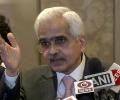
Reserve Bank Governor Shaktikanta Das on Wednesday said the decision to tweak policy rates was not in his hand as he himself is driven by the situation on the ground. In April, the Reserve Bank in a surprise move hit the pause button and decided to keep the key benchmark policy rate at 6.5 per cent. Prior to it, the Reserve Bank of India (RBI) was on a rate hiking spree, raising the repo rate by 250 basis points since May 2022.
The best part of the economy was its resilience, of course with a little help in the form of fiscal actions from the government to reverse the slow down, at a time when finance minister P Chidambaram was asked to take charge of the law and order machinery as home minister in the face of Mumbai terror attacks.

After a turnaround in performance by Indian equity markets since July that has seen the S&P BSE Sensex and the Nifty50 wipe out the year-to-date losses, analysts suggest investors start nibbling into stocks that are focused on the domestic economy. While they say intermittent corrections, led by policies of global central banks and other economic data, cannot be ruled out, analysts expect India's relative outperformance among global equity markets to continue as it looks better placed with a healthy economic recovery, and remains one of the fastest growing major economies. In this backdrop, Neeraj Chadawar, head of quantitative equity strategy at Axis Securities, believes that amid global slowdown, aggressive tightening by the central banks, and preference for domestic interests first (by the local government), export-oriented themes are likely to be muted or will deliver conservative returns in the near-term.
